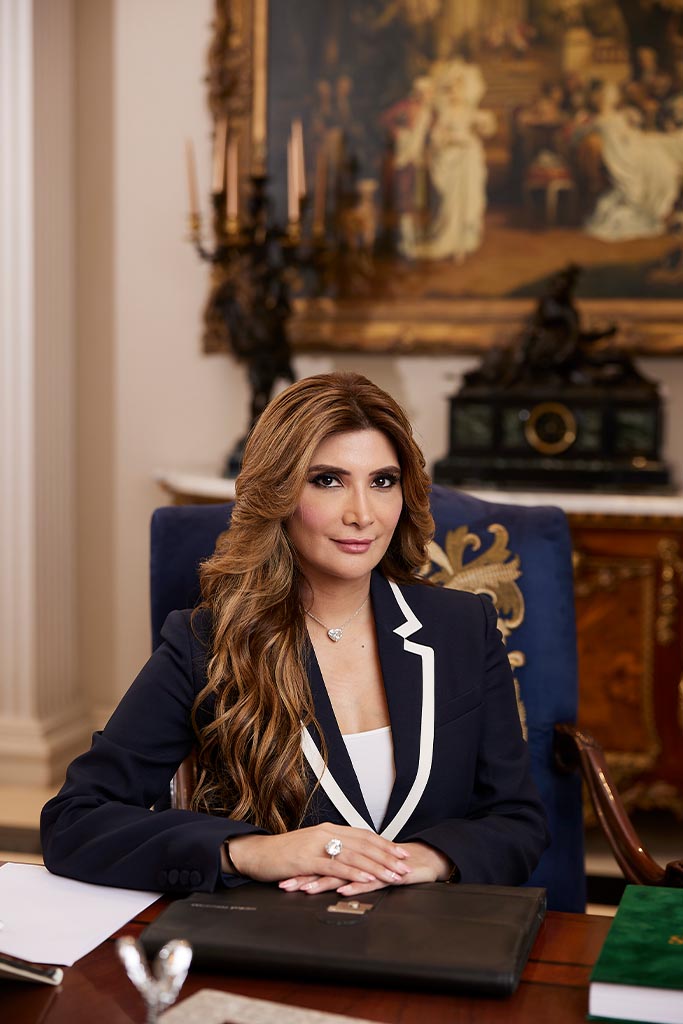
Director, Poonawalla Group
Some people choose a lane. Michelle Poonawalla chooses the entire road. As Managing Director of the Poonawalla Group and the Poonawalla Engineering Group, Michelle occupies one of India’s most prestigious seats of industrial leadership, steering a legacy enterprise with the precision of a strategist and the imagination of a creative.
Yet to define her by business alone would be to miss the fuller, richer picture entirely. Granddaughter of Jehangir Vazifdar, the celebrated architect of South Mumbai who counted M.F. Husain and S.H. Raza among his contemporaries, Michelle grew up in a home where art was not decoration, it was conversation.
Educated in Interior Design and Arts at the American College, London, she returned to India with a trained eye and a restless intellect, one that has since found expression across boardrooms, gallery walls, luxury interiors, and global conservation stages in equal measure.
Her art, which is technically adventurous and emotionally resonant, has been exhibited at the Saatchi Gallery in London, the Kochi-Muziris Biennale, the 7th Mediations Biennale in Poland, and the Parma Art Fair in Italy, among others.
Working at the intersection of video mapping, motion sensors, and traditional canvas, she uses her practice to explore memory, identity, climate change, and the fragility of the natural world.
Off the canvas, she is an equally committed philanthropist, with her family’s legacy spanning cancer care buildings, schools, and medical units across Pune, and a passionate environmental advocate who has lent her voice and visibility to causes from tiger conservation to elephant welfare.
Recipient of the Shiromani Award at the NRI World Summit 2022 in the United Kingdom, Michelle Poonawalla is, above all else, proof that the most compelling lives are the ones that refuse to be summarised.
1. As Director, you have been a catalyst for “revitalizing and modernizing” the group’s manufacturing operations. What is your philosophy on balancing the heritage of a long-standing group with the disruptive technologies of the modern industrial era?
Legacy provides both credibility and a sense of identity, but long-term relevance depends on the ability to evolve. The approach is to preserve core strengths, values, craftsmanship, and institutional knowledge while thoughtfully integrating advanced technologies that enhance efficiency and global competitiveness.
Modernization, in that sense, is not disruptive for its own sake. It is a calibrated progression that strengthens what already exists while preparing for what lies ahead.
2. Your strategic focus on Human Resources is credited with propelling the Poonawalla Group to new heights. In an increasingly automated world, why do you believe a “people-first” approach remains a business’s strongest competitive advantage?
While automation drives efficiency and consistency, it is people who bring context, judgment, and innovation. A people-first philosophy ensures that organizations remain agile and future-ready, because empowered individuals are more likely to anticipate change rather than react to it.
Investing in human capital builds not just capability but culture, and culture remains one of the most enduring differentiators in a highly automated world.
3. From heavy manufacturing to luxury interior development in Mumbai and Alibag, your portfolio is incredibly diverse. How do you shift your mindset when moving from the high-precision world of engineering to the aesthetic-driven world of luxury real estate?
Working across sectors requires an ability to operate with both precision and sensitivity. Engineering environments demand structured thinking, technical accuracy, and operational discipline, whereas luxury development is inherently experiential, requiring an understanding of aesthetics, emotion, and spatial storytelling.
The transition lies in adapting the lens, while maintaining a consistent commitment to excellence, detail, and long-term value creation across both domains.
4. You are often described as a “polymath of celebrated stature.” How does your background as an accomplished artist inform your “strategic acumen” when making high-stakes business decisions?
An artistic practice cultivates a heightened sense of awareness, the ability to observe, interpret, and engage with complexity more intuitively. This perspective becomes invaluable in strategic decision-making, particularly when navigating ambiguity or incomplete information.
It encourages lateral thinking, measured risk-taking, and a deeper appreciation for nuance, all of which contribute to more balanced and forward-looking business outcomes.
5. Under your guidance, your studio has undertaken an array of premium projects. Beyond the price point, what are the “Michelle Poonawalla” hallmarks of excellence that define a property as truly “luxury”?
True luxury lies in restraint, intention, and authenticity. It is reflected in the quality of materials, the precision of execution, and the coherence of the overall experience.
Beyond aesthetics, it is about creating spaces that evoke a sense of ease, belonging, and timelessness. The most refined environments are those where every element is considered, yet nothing feels excessive — an interplay of sophistication and subtlety.
6. You’ve used thought-provoking videos at international events to address climate change. To what extent do you believe a modern CEO is responsible for being a public advocate for global social and environmental issues?
The role of leadership today extends well beyond organizational boundaries. There is an increasing expectation and responsibility to engage with broader societal and environmental challenges.
Advocacy, however, must be grounded in credibility. It becomes meaningful when it is informed, consistent, and supported by tangible action within the organisation, ensuring that the external voice aligns with internal practice.
7. The Poonawalla family has a massive legacy of giving, from the Zavaray Poonawalla Cancer Building to the Soli Poonawalla School. How do you ensure these philanthropic endeavors are as strategically managed and impactful as your business ventures?
Philanthropy is most effective when it is approached with clarity, structure, and long-term intent. Rather than episodic contributions, the focus is on sustained engagement, measurable outcomes, and strong governance frameworks.
This ensures that initiatives create lasting impact, whether in education, healthcare, or community development, and move beyond short-term relief to meaningful transformation.
8. A fascinating aspect of your group is the humanitarian assistance provided to the Poona District Leprosy Committee by outsourcing component manufacturing to them. How can other corporations look at their own supply chains as a tool for social good?
Supply chains present a unique opportunity to integrate social impact into core operations. By partnering with organisations such as the Poona District Leprosy Committee, businesses can create employment ecosystems that restore dignity and foster inclusion.
It is a model that demonstrates how operational efficiency and social responsibility can coexist and even reinforce one another.
9. With the Yohan Poonawalla Foundation’s support for the Neuro Trauma Unit at Ruby Hall Clinic and various educational institutions, how do you select which socio-economic sectors are most in need of your group’s “munificent donations”?
The selection process is guided by both immediacy and long-term relevance. Sectors such as healthcare and education naturally emerge as priorities due to their foundational role in societal progress.
Supporting institutions like Ruby Hall Clinic reflects a commitment to strengthening infrastructure that has both immediate life-saving impact and sustained community value.
10. With the Shiromani Award for your contributions to the Arts and your leadership in the industrial sector, what is the next “new height” you are determined to steer the Poonawalla Group toward?
The next phase is centred on building an ecosystem that is resilient, forward-looking, and globally competitive. This involves embracing innovation, strengthening operational excellence, and embedding sustainability into decision-making at every level.