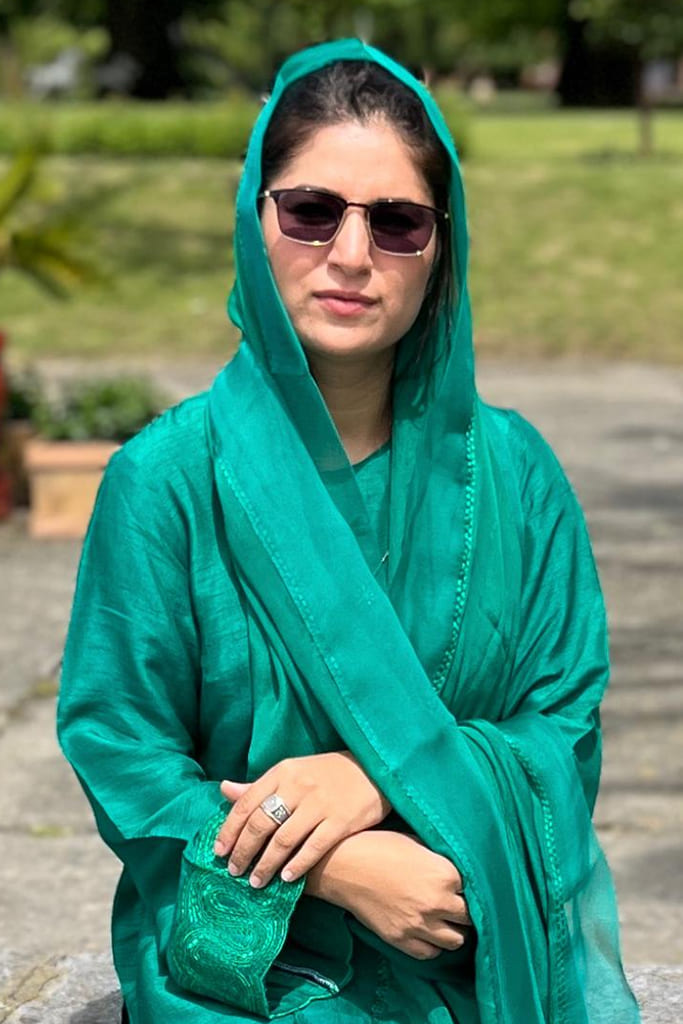
There are individuals who encounter the world’s suffering and look away, and there are those who step forward and refuse to let it remain unchanged. Yashika Shaikh belongs, unequivocally, to the latter. A social activist, a certified nutritionist, and the founding force behind the SURAJ Welfare and Charitable Society, she has spent the better part of two decades weaving together threads of healthcare, education, cultural preservation, and women’s empowerment into a tapestry of real, lasting transformation. Her story is not one of sudden illumination or a single defining moment; it is, instead, a quiet and resolute accumulation of choices made in service of others, stretching from the foothills of Uttarakhand to the corridors of New Delhi and far beyond.
Roots of Resolve
The seeds of Yashika’s life mission were planted long before she had the vocabulary to name what she was doing. Born into a family that placed extraordinary value on service and kindness, she was shaped, from her earliest years, by parents whose teachings on compassion and responsibility toward others left an indelible impression. By 2008, the year she enrolled at Graphic Era University in Dehradun to pursue her bachelor’s degree in Business Management and Marketing, that impression had already crystallised into intent. It is worth pausing on this detail, for it reveals much about the woman Yashika was becoming. While most students of her age were focused exclusively on carving out personal futures, Yashika was simultaneously laying the groundwork for something far greater than herself. The same year she began her undergraduate studies, she co-founded SURAJ Welfare and Charitable Society, an organisation that would grow, over the next decade and a half, into one of the most quietly impactful NGOs operating across India today.
A Life Lived in Parallel
What distinguishes Yashika Shaikh from many of her contemporaries in the social sector is the remarkable duality with which she has lived her professional life. For over nine years, from 2015 through 2024, she served as an Assistant Manager at AAMOGH TRADEX Pvt. Ltd. in New Delhi, navigating the demands of the corporate world with the same discipline and commitment she brought to her humanitarian work. Far from being in contradiction, these two spheres informed and strengthened each other. The organisational acumen she honed in the boardroom enriched her ability to lead and scale SURAJ, while her experiences on the ground gave her a moral grounding that few in the corporate world possess.
As a nutritionist, she has brought an additional dimension to her work. In communities where malnutrition and its effects of poverty persist, Yashika’s ability to integrate health and nutrition education into SURAJ’s programmes has meant that the organisation’s interventions address not just the symptoms of deprivation, but some of its most stubborn underlying causes. Her approach is holistic in the truest sense of the word: she does not see a child in need of food as separate from a woman in need of dignity, or a young artist in need of economic stability as separate from a community in need of cultural continuity.
The SURAJ Story: Light in the Margins
The name SURAJ, meaning “sun” in Hindi, was chosen with intention, for the organisation was conceived as a source of light for those living in the margins of society. Formally registered and operational since 2008, the SURAJ Welfare and Charitable Society has grown into a pan-India organisation with its roots firmly planted in Dehradun, Uttarakhand, and its reach extending across states and communities that rarely feature in the conversations of privilege.
At the heart of SURAJ’s philosophy is a conviction that health and hygiene form the bedrock of any meaningful social upliftment. The organisation’s mission, articulated with striking clarity, is to construct a self-sustaining social infrastructure that addresses multiple, interconnected challenges. In practice, this translates into an expansive web of programmes that span four interconnected domains: women’s empowerment, child welfare and education, cultural sustainability, and health and hygiene outreach.
SURAJ’s work in women’s empowerment is perhaps its most far-reaching contribution. Less privileged women are supported through carefully designed programmes in health awareness, personal hygiene, and skill development, with the explicit goal of equipping them not merely to survive, but to achieve genuine self-reliance.
These are not short-term interventions; they are sustained engagements that walk alongside women as they move toward economic and personal independence. The organisation’s child welfare model is equally ambitious. SURAJ has developed what its beneficiaries refer to as a holistic support structure, one that accompanies children from their earliest years through to a point of self-sufficiency. This is a profound commitment, one that requires consistency, resources, and an unwavering belief in the potential of every child, regardless of the circumstances of their birth.
Through educational outreach, donation drives, and partnerships with other welfare bodies, SURAJ ensures that children facing poverty, abuse, or neglect are not simply given temporary relief, but are provided with the foundations for a different future.
“SURAJ does not offer charity. It offers the architecture of a different life.”
Culture as a Livelihood
One of the most distinctive and visionary aspects of SURAJ’s work lies in its approach to cultural sustainability. Through a significant partnership with VEVA ART, Yashika has championed the cause of Madhubani art, an ancient and intricate folk tradition whose practitioners are, in many cases, among the most economically vulnerable artisans in India.
Rather than treating culture as an afterthought to material welfare, SURAJ has positioned it as an economic resource and a source of pride, helping local artists find markets and recognition for their craft. This dimension of SURAJ’s work reflects Yashika’s understanding that human dignity is not reducible to food, shelter, and healthcare alone. A community that loses its cultural heritage loses something irreplaceable, and Yashika, through her advocacy and partnerships, has worked to ensure that tradition and livelihood are not in competition, but are mutually reinforcing.
The New Wave Art Initiative has recognised SURAJ’s contributions in this domain, lending further credibility to an approach that has quietly transformed the lives of artists who might otherwise have been compelled to abandon their craft.
Recognition Hard-Earned and Well-Deserved
In October 2024, Yashika Shaikh and SURAJ received recognition of a particularly meaningful kind. Mr. Kailash Gahlot, Cabinet Minister for the Government of Delhi, formally acknowledged the organisation’s continuous and impactful efforts in empowering women and supporting vulnerable communities.
For an NGO that has operated largely away from the spotlight, preferring results over recognition, this governmental acknowledgement represented a significant and well-earned validation of years of devoted work. Around the same time, prominent media personality Viral Bhayani chose to spotlight Yashika’s work in women’s healthcare and community empowerment, bringing the story of SURAJ to an audience that extended well beyond the communities the organisation serves.
These twin moments of recognition—one institutional and one public—offered a rare convergence: the work had reached a scale where it could no longer remain invisible. Yet, it is worth noting that Yashika has never appeared to measure her success in awards or accolades. Her secretary role at SURAJ, held with quiet dedication since March 2010, speaks to a person far more invested in the slow, unglamorous work of institution building than in the theatre of public recognition.
A Light That Keeps Spreading
To understand Yashika Shaikh is to understand that genuine change requires a particular kind of tenacity: the kind that does not depend on applause, that does not diminish in the face of setbacks, and that finds its sustenance not in outcomes alone, but in the act of showing up, day after day, for those who have not been shown up for.
She has built, over the course of more than fifteen years, an organisation that aligns itself with the United Nations’ Sustainable Development Goals, working toward better health, expanded education, reduced inequality, environmental awareness, and inclusive economic growth. SURAJ does not ask for gratitude from the communities it serves. It asks only for the chance to be useful, and to keep going.
In this, it mirrors the woman at its helm: purposeful, consistent, and quietly extraordinary.
As this edition’s cover personality, Yashika Shaikh is not merely a story worth telling. She is a reminder of what becomes possible when a single person refuses to mistake comfort for contentment, and chooses, instead, the far more demanding and far more rewarding path of service.